Joining Overture Places to Google Place IDs

· 12 min read
Aden Forshaw
API Creator / CEO ThatAPICompany

Every place in the Overture Maps API has a GERS ID, Overture's stable identifier. It's the right key for your own database, and it's openly licensed. But your users, partners and other tools often speak Google: an "open in Google Maps" button, a booking link, a CRM record that already holds a Google place ID.

This post builds a small layer over the API that adds a google_place_id to each Overture place. We tested it on 120 places across Sydney, and it matched 114. It's the first in a series on joining Overture places to third-party services. Tripadvisor and Yelp come next.

Two stacked map layers over Sydney Harbour, with lines joining each place on the lower Overture layer to its match on the layer above

Type-Ahead Place Search with name_prefix

· 4 min read
Aden Forshaw
API Creator / CEO ThatAPICompany

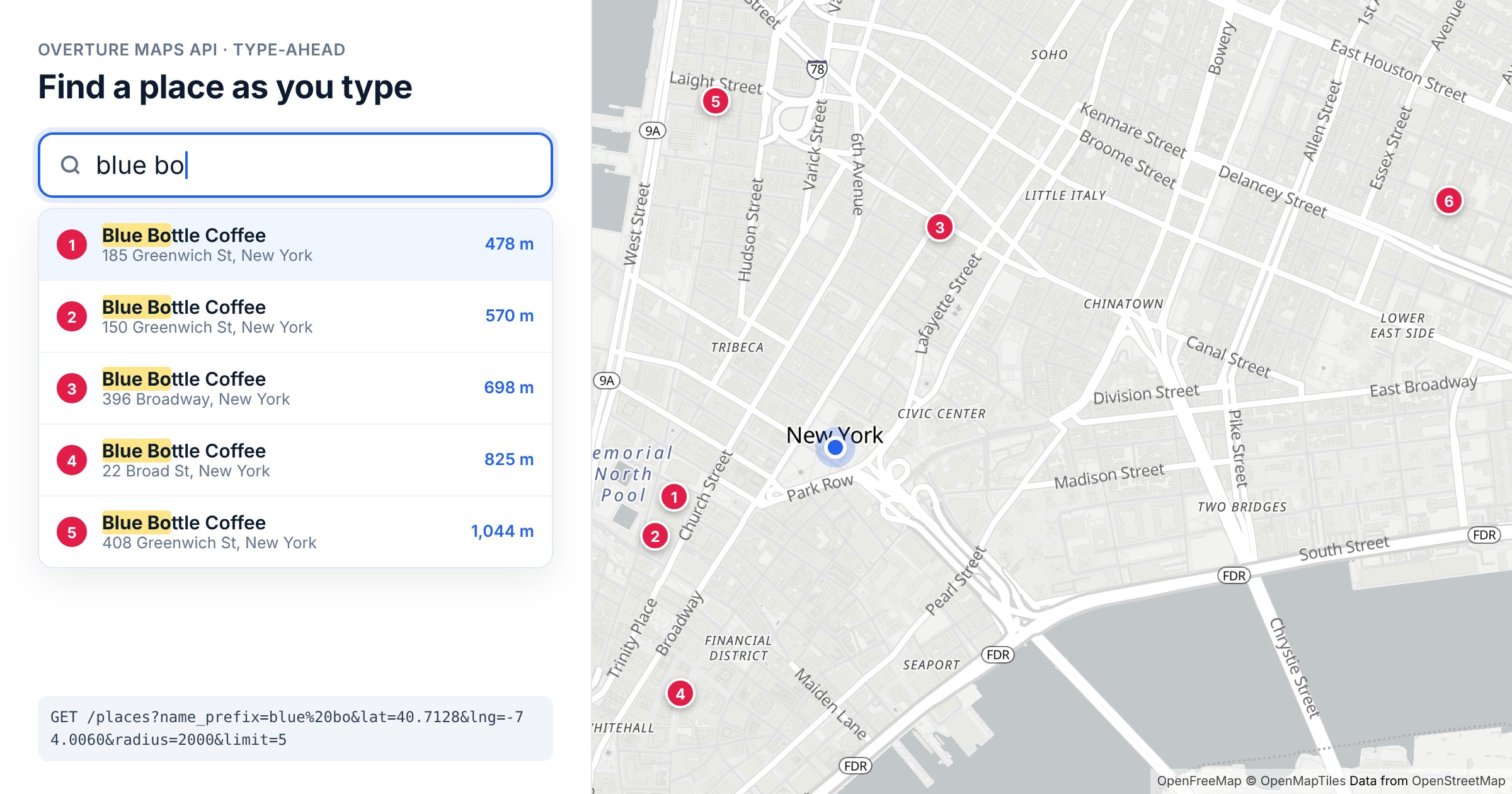
You can now search Overture places by the first few letters of their name. Type "blue bo" near Lower Manhattan and the API returns the Blue Bottle Coffee shops around you, nearest first. That's the building block for the location field every app needs: a box that suggests places as someone types.

A search box with "blue bo" typed, suggesting five Blue Bottle Coffee shops in New York with their distances, next to a map of all six

Overture Removed categories. Your Code Still Works.

· 3 min read
Aden Forshaw
API Creator / CEO ThatAPICompany

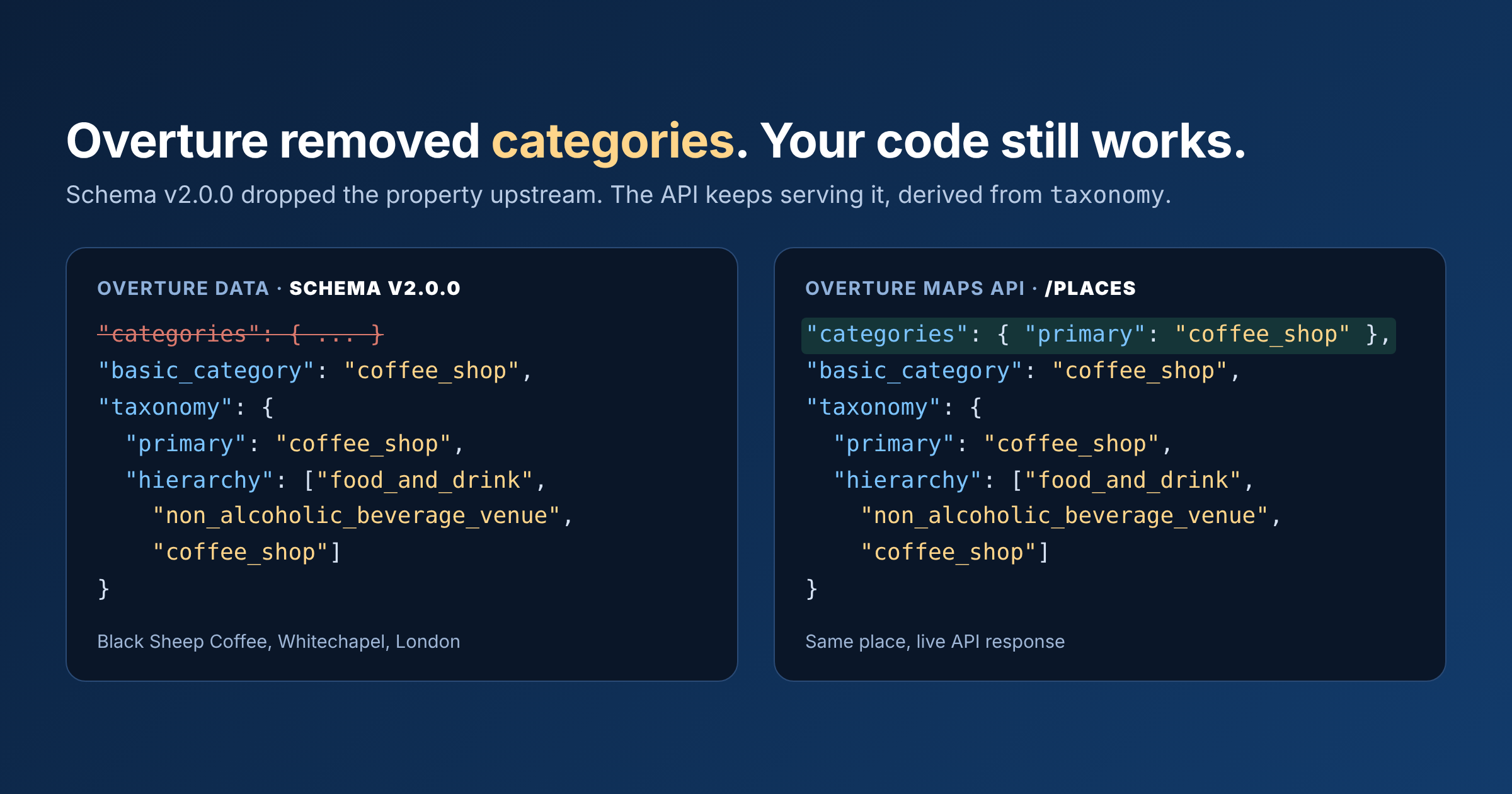
Overture's September 2026 release (2026-09-23.0, schema v2.0.0) removed the categories property from places entirely. If you query the raw GeoParquet, every query that touched categories needed rewriting. If you use the Overture Maps API, nothing broke: the categories field and filter still work, now derived from Overture's new taxonomy.

Overture's schema v2.0.0 record without categories, next to the API response for the same place with categories still present

Brand Logos, Websites and Corporate Parents — Wikidata Enrichment Is Live

· 4 min read
Aden Forshaw
API Creator / CEO ThatAPICompany

Every branded place in the API now comes with the option of a brand logo, the brand's official website, its industry, and its parent organisation — joined live from Wikidata, the free CC0 knowledge base. Brand pickers, store locators and map popups just got a visual upgrade, with zero changes required to your existing integration.

New in the API: Places Taxonomy, Operating Status, and Division Admin Levels

· 4 min read
Aden Forshaw
API Creator / CEO ThatAPICompany

Overture's 2026 schema releases brought a wave of useful new properties, and they're all live in the API today: a hierarchical places taxonomy you can filter by, an operating status on every place, admin levels on divisions, and per-source licence info across every theme. Everything is additive — your existing integrations keep working without touching a line of code.

Divisions API Upgrade: Search by Name, Filter by Viewport, Fetch by ID

· 4 min read
Aden Forshaw
API Creator / CEO ThatAPICompany

The /divisions endpoint just got its biggest upgrade yet. You can now search administrative areas by name — countries, regions, counties, cities, neighborhoods — filter by subtype and map viewport, and fetch any division's full polygon by ID. Searches cover all 1M+ Overture division areas worldwide and typically return in well under a second, making them fast enough to power a live search box.

Securing Your Overture Maps API Keys with Domain Locking

· 3 min read
Aden Forshaw
API Creator / CEO ThatAPICompany

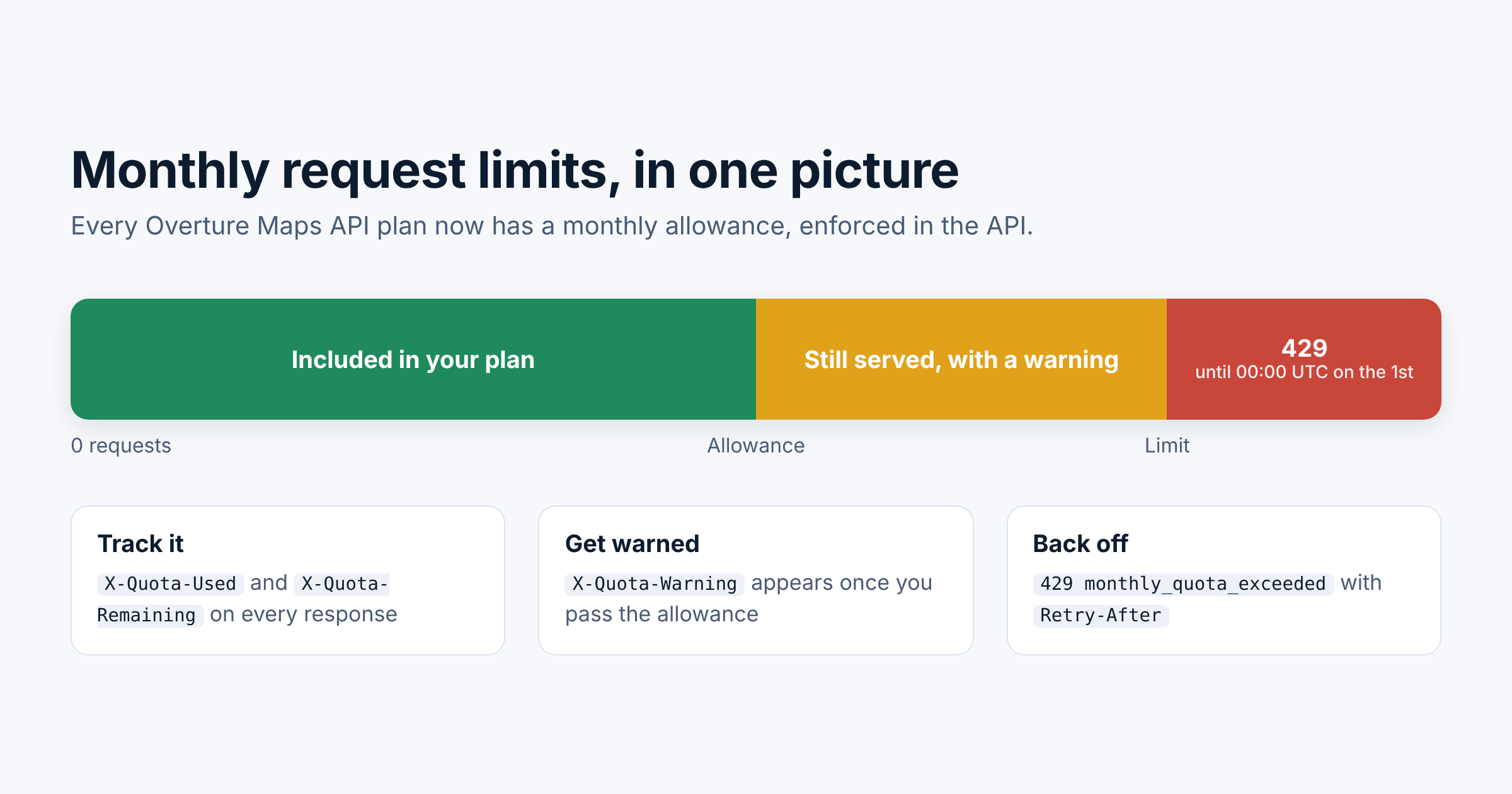
We are excited to introduce API Key Domain Locking for the Overture Maps API!

If you are building public-facing web applications or interactive maps, you likely expose your API key directly in client-side Javascript code. To prevent unauthorized websites from stealing your API key and using your quota, you can now restrict your key's usage to specific domains.

Enriched Place Data

· 4 min read
Aden Forshaw
API Creator / CEO ThatAPICompany

When we first launched Overture Maps API, our goal was simple: make the power of the Overture Maps Foundation datasets easily accessible to developers through a modern API. The project started as an open-source codebase that anyone could deploy to Cloud Run with a free GCP account and some starter credits. That approach has been a success — developers around the world are now using the API to power location-based apps, retail search, analytics, and more.

But for many customers, the question quickly became: what comes next?

Why Enriched Data?​

The Overture dataset is already a huge leap forward compared to raw OpenStreetMap. Backed by contributors like Meta, Microsoft, and others, it brings consistent schema, deduplication, and global coverage. Still, we saw that real-world use cases often need more context than what’s available out of the box.

Think about:

  • Retail chains wanting brand metadata (e.g. “Starbucks” vs just a coffee shop).
  • Analytics teams wanting to filter by categories more precisely.
  • Businesses needing country-specific datasets layered on top of Overture for compliance, reporting, or localized detail.

That’s why we’re introducing Enriched Data.

How Enriched Data Works​

Enriched Data builds on the core Overture Places schema by joining in additional datasets hosted inside our own infrastructure. These include proprietary or curated datasets that we’ve licensed or created, which can be matched directly to Overture’s stable id field for Places/POIs.

For example:

  • Add brand attributes so you can query for every “Woolworths” in Australia or every “Whole Foods” in the US.
  • Join in government inspection datasets or local licensing records (where available).
  • Blend open-source projects like AllThePlaces with Overture to fill in coverage gaps and keep places fresh.

From a developer’s perspective, you don’t need to change how you use the API. You can query enriched endpoints just like you query the base dataset — and you’ll get back richer metadata.

👉 Check out the Enriched Data documentation for full details on schemas, fields, and availability.

Open Source + Hosted Service​

We’ve kept to our original promise: Overture Maps API remains open source. Anyone can deploy it themselves to GCP using BigQuery as the backend, and take advantage of the free tier credits to get started.

But if you want the Enriched Data experience, that’s available only on our hosted service. This hybrid approach gives developers maximum flexibility:

  • Self-host for free if you just need the base Overture data.
  • Use our hosted API if you want low-latency access to global coverage, plus enriched datasets you can’t get elsewhere.

It’s the same API, same endpoints, just more powerful when you need it.

What’s Next​

Enriched Data is just the start. We’re already working on:

  • Advanced tags for more precise categorization and filtering
  • Translations & localization for place names and descriptions in multiple languages
  • Opening hours & dates including seasonal variations and holiday schedules
  • Website URLs and social media links for businesses
  • Footfall data (country dependent) for understanding location traffic patterns
  • Photos tied to store fronts, interiors, and POIs
  • Restaurant menus with pricing and dietary information
  • Cross-platform conflation to link the same place across TripAdvisor and other mapping services
  • Contact us for more... custom enrichment options

Our vision is clear: to make Overture Maps API the go-to open + enriched location platform that balances flexibility, cost, and licensing freedom with the kind of metadata richness that unlocks enterprise use cases.


🚀 Ready to explore? Start with the demo app or dive into the docs. If you’re interested in access to enriched datasets, get in touch with us — we’d love to hear what you’re building.


Would you like me to make this more developer-focused (code snippets, API response examples with enriched fields), or more business-facing (highlighting use cases, ROI, enterprise value)?