Monthly Request Limits and the X-Quota Headers

Every Overture Maps API plan now includes a monthly allowance of requests, and the API itself keeps count. You'll see your usage on every response, get a warning before anything is refused, and only successful requests count. Here's how it works and how to handle it in your code.
Why we count requests
Some queries read far more data than others, and a limit in bytes is impossible to plan around: you can't tell in advance how much a query will scan. Counting requests is simple and predictable, and it keeps the Free plan sustainable.
How the limit works
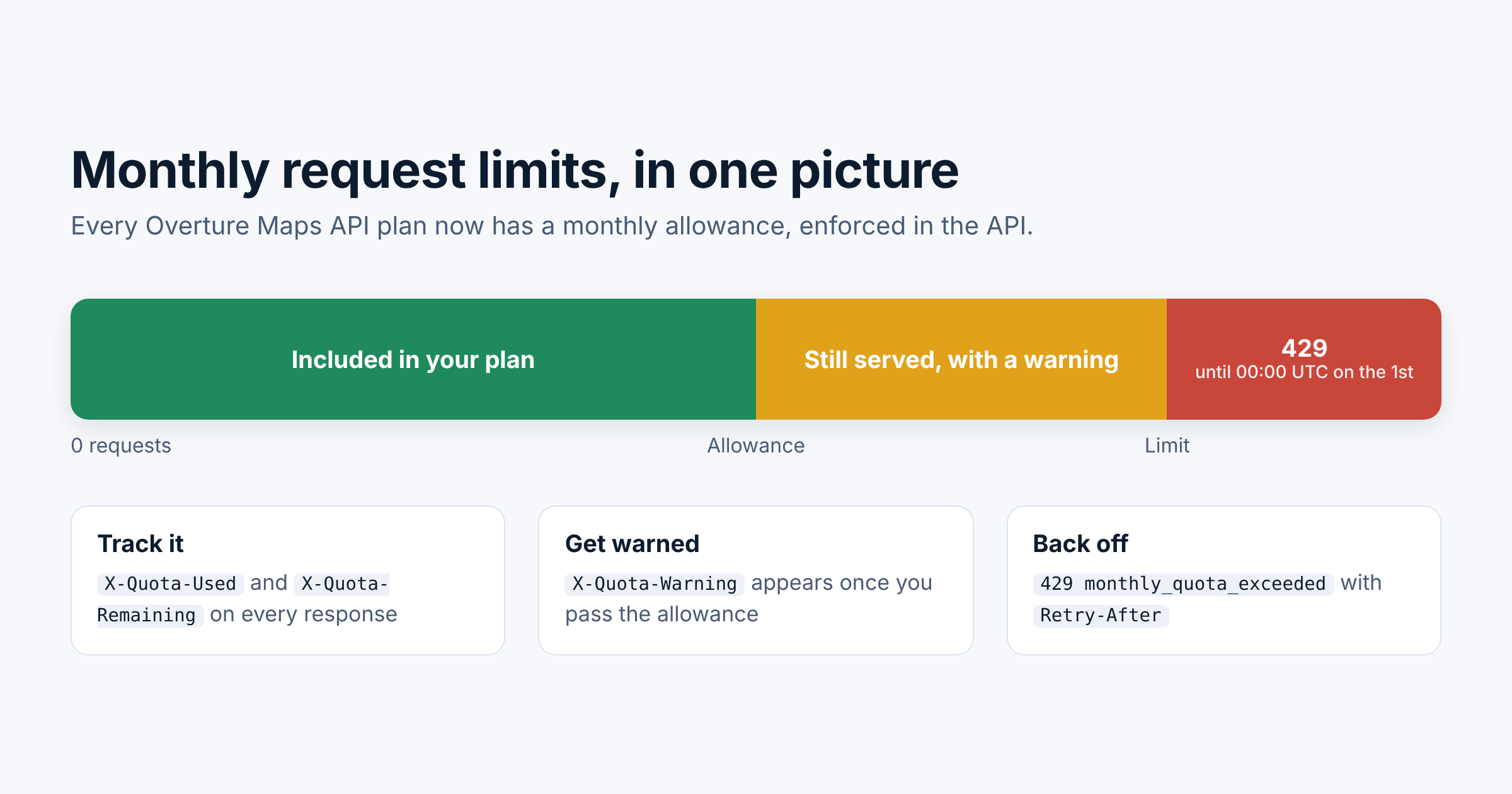
Each month runs in three stages:
- Within your allowance: everything works as normal.
- Past your allowance: requests still work, but every response carries an
X-Quota-Warningheader saying so. - At your plan's limit: requests return
429with"error": "monthly_quota_exceeded"and aRetry-Afterheader, until the count resets at 00:00 UTC on the 1st.
Each plan's allowance is on the pricing page, and the full rules are in Usage limits.
What counts
Only successful requests count. A response with a status of 400 or above never uses up your allowance, including validation errors, 403s and every 429.
There's also a short per-minute rate limit, separate from the monthly count. Going over it returns a 429 that says so; wait a minute and retry.
The headers
Every response to a key with a monthly limit carries:
| Header | Meaning |
|---|---|
X-Quota-Plan | Your plan |
X-Quota-Limit | Your monthly allowance |
X-Quota-Hard-Limit | The point where requests are refused |
X-Quota-Used | Requests counted so far this month |
X-Quota-Remaining | Requests left before the allowance |
X-Quota-Reset | When the count resets (Unix seconds, UTC) |
X-Quota-Warning | Present once you're past the allowance |
They're exposed through CORS, so browser code can read them too.
Handling it in code
Read the headers on every call, slow down once the warning appears, and treat the monthly 429 as "wait until the reset" rather than something to retry:
export async function overture(path: string, params: Record<string, string>) {
  const res = await fetch(`https://api.overturemapsapi.com${path}?${new URLSearchParams(params)}`, {
    headers: { "x-api-key": process.env.OVERTURE_API_KEY! },
  });

  const remaining = Number(res.headers.get("X-Quota-Remaining"));
  const warning = res.headers.get("X-Quota-Warning");
  if (warning) console.warn(`Overture quota: ${warning}`);

  if (res.status === 429) {
    const body = await res.json();
    if (body.error === "monthly_quota_exceeded") {
      const resetAt = new Date(Number(res.headers.get("X-Quota-Reset")) * 1000);
      throw new Error(`Monthly limit reached; resets ${resetAt.toISOString()}`);
    }
    // Per-minute limit: back off and retry
    const wait = Number(res.headers.get("Retry-After") ?? 60);
    await new Promise((r) => setTimeout(r, wait * 1000));
    return overture(path, params);
  }

  if (!res.ok) throw new Error(`Overture API ${res.status}`);
  return { data: await res.json(), remaining };
}
Two habits that stretch an allowance a long way: cache responses on your side (results only change with Overture's monthly data release), and round coordinates before you query so nearby users share the same request.
We'll also email your team once when you pass the allowance and once if you reach the limit, so it never comes as a surprise.
Country-level queries are on paid plans
A /places query with a country and no lat/lng reads a whole country, the most expensive query the API serves. It's now a paid-plan feature. On the Free plan, search by lat, lng and radius (up to 25 km); country still works as an extra filter alongside them. A Free key sending a country-level query gets a 403 explaining why, and it doesn't count towards your allowance.
The demo key
DEMO-API-KEY has no monthly count. It's for trying the API: lat/lng searches around a few demo cities (New York, London, Paris and Sydney), with small pages. Sign up for a free key to search anywhere.