Overture Removed categories. Your Code Still Works.

Overture's September 2026 release (2026-09-23.0, schema v2.0.0) removed the categories property from places entirely. If you query the raw GeoParquet, every query that touched categories needed rewriting. If you use the Overture Maps API, nothing broke: the categories field and filter still work, now derived from Overture's new taxonomy.
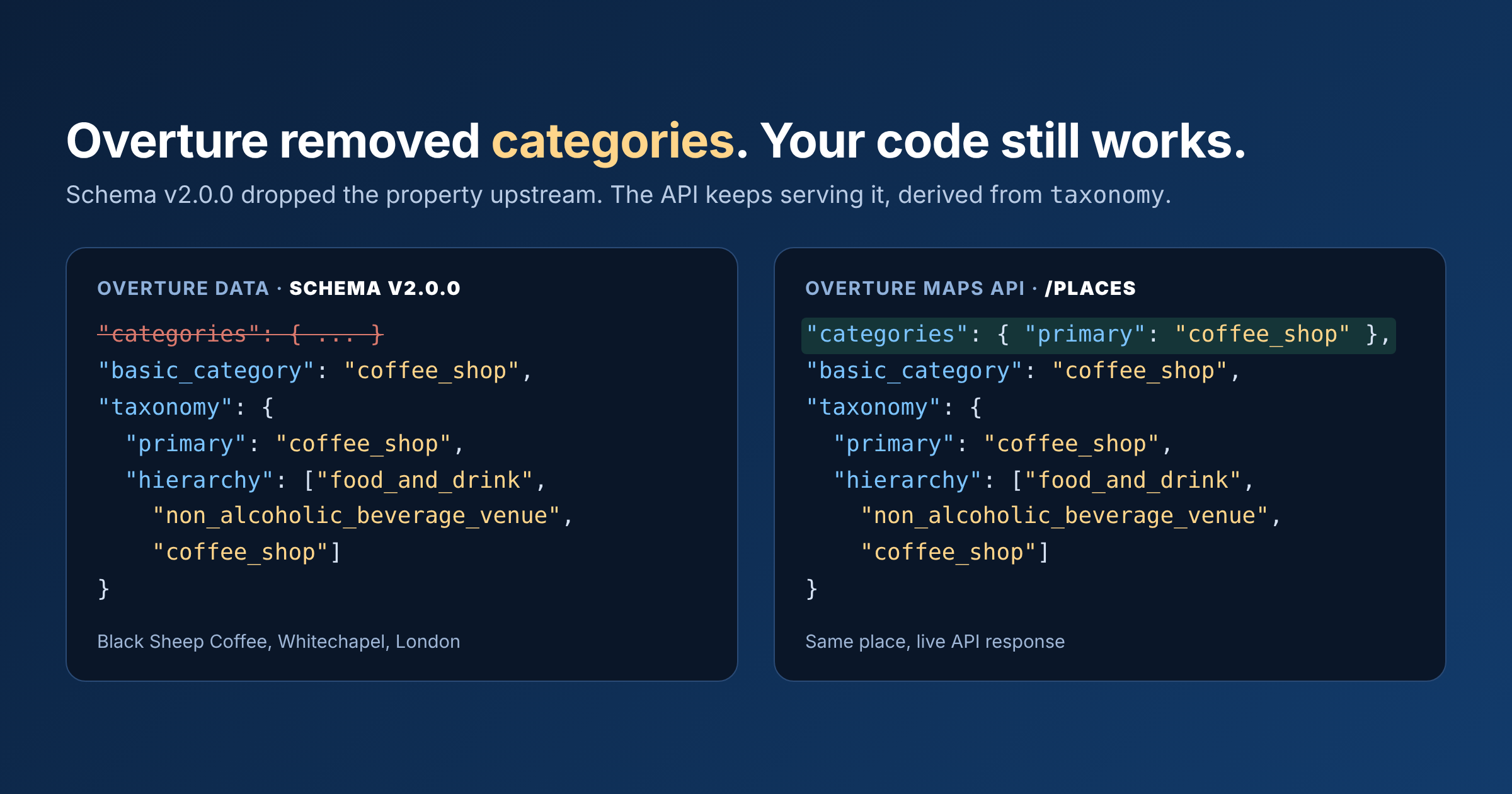
What changed upstream
Since schema v2.0.0, a place carries two category fields instead of three:
taxonomy: the primary category, its full path from the top-level group down (hierarchy), and any alternates.basic_category: a coarser label, handy for icons and map legends.
The old categories object (primary plus alternate) is gone from the data.
What the API does
We kept categories in every /places response and kept the categories filter, both derived from taxonomy. Here's a coffee shop in Whitechapel, London, as the API returns it today:
curl -H "x-api-key: DEMO-API-KEY" -X GET -G 'https://api.overturemapsapi.com/places' \
-d 'lat=51.5145' -d 'lng=-0.0754' -d 'radius=300' -d 'categories=coffee_shop' -d 'limit=1'
"names": { "primary": "Black Sheep Coffee" },
"categories": { "primary": "coffee_shop", "alternate": [] },
"basic_category": "coffee_shop",
"taxonomy": {
  "primary": "coffee_shop",
  "hierarchy": ["food_and_drink", "non_alcoholic_beverage_venue", "coffee_shop"],
  "alternates": []
}
/places/categories now lists taxonomy values, so the list you pick filters from matches what the filter accepts.
The one thing to check
The values inside categories now follow the taxonomy vocabulary. If your code filters on a category string that doesn't exist in the taxonomy, it now matches nothing, with no error.
categories is an exact match. Within 1 km of Bondi Beach, categories=cafe returns a full page of 25, while categories=cafes returns none. If a filter that used to return results now comes back empty, check the string against /places/categories first.
Why taxonomy is the better filter
taxonomy matches a place's primary category or any ancestor in its hierarchy, so one broad value covers everything beneath it. categories only matches the exact value. Around Bondi (1 km), the same value gives very different results:
| Filter | Places returned |
|---|---|
categories=non_alcoholic_beverage_venue | 2 |
taxonomy=non_alcoholic_beverage_venue | 22 |
The taxonomy search picks up every coffee shop, juice bar and tea room, because each sits under non_alcoholic_beverage_venue in its hierarchy. The categories search only finds the two places whose own category is that value.
Moving over
- Filters: swap
categories=fortaxonomy=wherever you mean "this kind of place and everything under it". Keepcategories=only where you want an exact category. - Display: read
taxonomy.primaryfor the specific label, orbasic_categoryfor a coarser one. Both are on every place. - Pickers: build category dropdowns from
/places/categories, which acceptslat,lngandradius, so you only offer categories that exist near the user.
// Before: exact category strings
const before = new URLSearchParams({ lat, lng, radius: "1000", categories: "coffee_shop,cafe" });

// After: one hierarchy-aware value
const after = new URLSearchParams({ lat, lng, radius: "1000", taxonomy: "non_alcoholic_beverage_venue" });
There's no deadline to switch. categories stays in the API. But taxonomy is where Overture is putting its effort, and it does more with less.
The full release notes are in our changelog and in Overture's 2026-09-23 release post.