Filter Overture places by category
Overture removed the old categories property from its places data in September 2026 and now describes every place three ways: a taxonomy with a full hierarchy, a short basic_category, and (in this API) a categories field kept for compatibility. Pick the wrong one and your "restaurants" list quietly misses half the restaurants. With the raw release you would work this out in DuckDB against the GeoParquet. With the Overture Maps API it's a query parameter, and the Pagination-Count header tells you exactly what each choice returns.
This guide compares the filters around Tompkins Square Park in New York. New York is one of the demo key's cities, so every request below works as written with DEMO-API-KEY. Swap in your own coordinates and your own key when you're ready to go anywhere else.
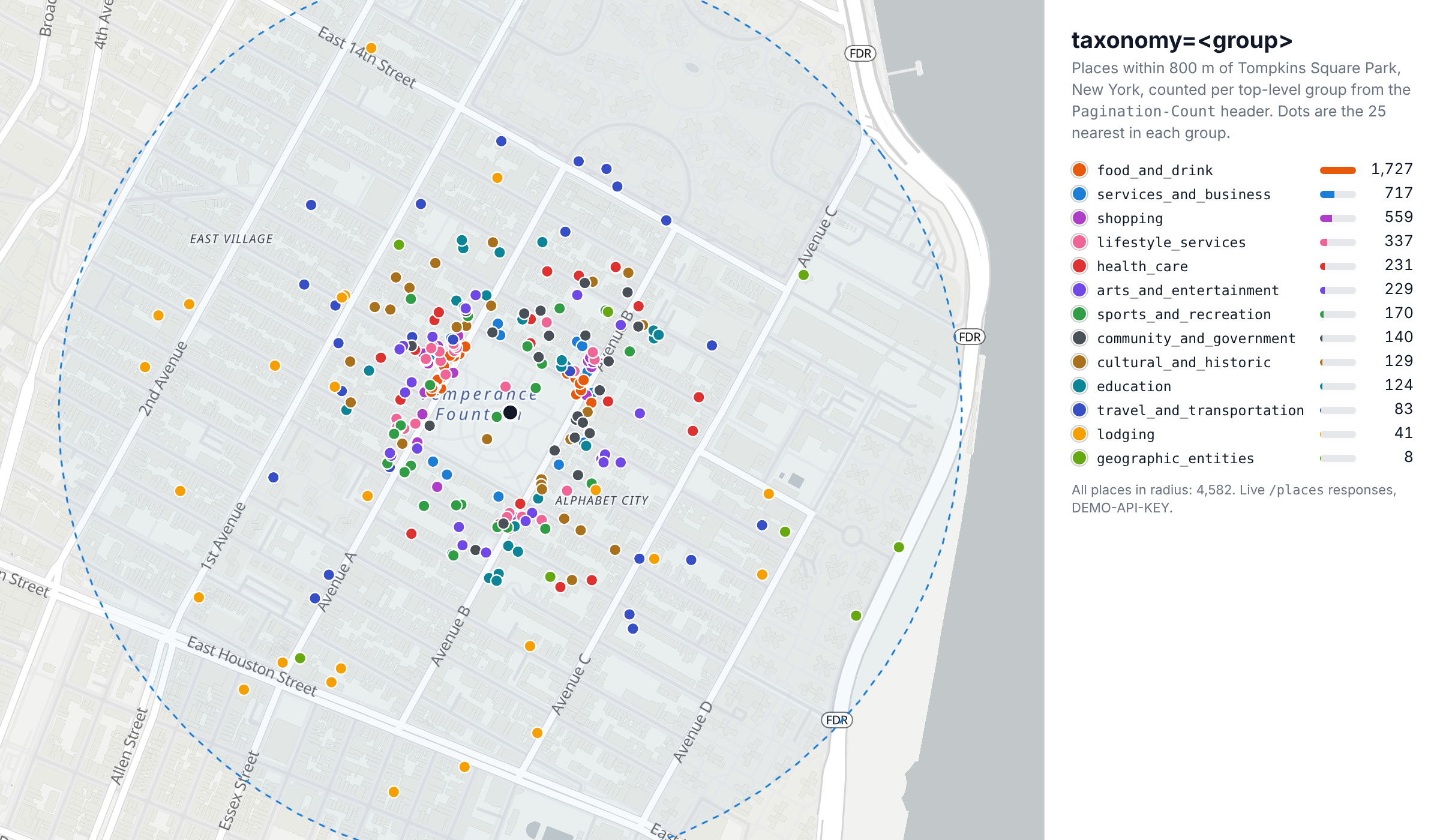
/places responses. Dots are the 25 nearest places in each group. Map: OpenFreeMap, © OpenMapTiles, data © OpenStreetMap contributors.
What you'll build
A clear rule for every category filter you write:
taxonomyfor a whole branch, from "all food and drink" down to "every Asian restaurant"categoriesfor exact values, including Overture's simplifiedbasic_category- comma-separated lists for "this or that", and two parameters for "this and that"
- a small TypeScript helper that counts what a filter returns before you ship it
Step 1: Read a place's category fields
Ask for one place and only its category fields with includes:
curl -H "x-api-key: DEMO-API-KEY" -X GET -G 'https://api.overturemapsapi.com/places' \
-d 'lat=40.7265' -d 'lng=-73.9815' -d 'radius=800' -d 'name_prefix=ninth' -d 'limit=1' \
-d 'includes=names,categories,basic_category,taxonomy'
{
  "properties": {
    "names": { "primary": "Ninth Street Espresso" },
    "categories": { "primary": "coffee_shop", "alternate": [] },
    "basic_category": "coffee_shop",
    "taxonomy": {
      "primary": "coffee_shop",
      "hierarchy": ["food_and_drink", "non_alcoholic_beverage_venue", "coffee_shop"],
      "alternates": []
    }
  }
}
taxonomy.primary is the place's own category. taxonomy.hierarchy is the path from one of 13 top-level groups down to it. basic_category is a coarser label: Overture's taxonomy guide describes about 280 of them, meant for map icons and simple pickers. For a coffee shop all three agree. For most places they don't:
| Place type | taxonomy.primary | basic_category | hierarchy |
|---|---|---|---|
| Ramen | ramen_restaurant | restaurant | food_and_drink > restaurant > asian_restaurant > ramen_restaurant |
| Bakery | bakery | casual_eatery | food_and_drink > casual_eatery > bakery |
| Café | cafe | cafe | food_and_drink > casual_eatery > cafe |
Step 2: Broad filters with a top-level group
taxonomy matches a place's own category or any ancestor, so a top-level group returns everything beneath it. Read the total from the Pagination-Count header and you don't need to download the places at all:
curl -s -D - -o /dev/null -H "x-api-key: DEMO-API-KEY" -G 'https://api.overturemapsapi.com/places' \
-d 'lat=40.7265' -d 'lng=-73.9815' -d 'radius=800' -d 'taxonomy=food_and_drink' -d 'limit=1' \
| grep -i pagination-count
pagination-count: 1727
Here are all 13 groups within 800 m of the park:
| Group | Places |
|---|---|
food_and_drink | 1,727 |
services_and_business | 717 |
shopping | 559 |
lifestyle_services | 337 |
health_care | 231 |
arts_and_entertainment | 229 |
sports_and_recreation | 170 |
community_and_government | 140 |
cultural_and_historic | 129 |
education | 124 |
travel_and_transportation | 83 |
lodging | 41 |
geographic_entities | 8 |
The search with no category filter returns 4,582 places. The groups add up to 4,495, because a few places carry no taxonomy, so a group filter never returns quite everything. Profile a neighbourhood turns these counts into shares and compares two areas.
Step 3: Narrow down the same branch
The same parameter works at any depth. Each step down the restaurant branch returns a subset of the one above:
| Filter | Places |
|---|---|
taxonomy=food_and_drink | 1,727 |
taxonomy=restaurant | 1,011 |
taxonomy=asian_restaurant | 292 |
taxonomy=east_asian_restaurant | 174 |
taxonomy=japanese_restaurant | 103 |
taxonomy=ramen_restaurant | 14 |
Watch where things actually sit. ramen_restaurant hangs directly off asian_restaurant, not off japanese_restaurant, so taxonomy=japanese_restaurant leaves out all 14 ramen places. If your "Japanese" chip should include ramen, ask for both: taxonomy=japanese_restaurant,ramen_restaurant returns 117.
The same thing happens with coffee. coffee_shop lives under non_alcoholic_beverage_venue, while cafe lives under casual_eatery, so no single branch below food_and_drink holds both.
Step 4: Exact filters with categories
categories doesn't follow the hierarchy. It matches a place whose own category or basic_category equals the value you pass. That makes it a quick way to filter by Overture's simplified labels:
| Value | taxonomy= (branch) | categories= (exact or basic) |
|---|---|---|
ramen_restaurant | 14 | 14 |
japanese_restaurant | 103 | 58 |
asian_restaurant | 292 | 12 |
restaurant | 1,011 | 1,014 |
casual_eatery | 288 | 216 |
lodging | 41 | 16 |
Read the rows like this:
- Leaf categories such as
ramen_restaurantgive the same answer either way. - Middle branches such as
asian_restaurantdiffer sharply.categories=asian_restaurantreturns only the 12 places tagged with exactly that value, not the sushi, Indian and Thai places beneath it. - Basic categories such as
restaurantlook similar but aren't the same set.categories=restaurantmatches every place whosebasic_categoryisrestaurant, so nearly every restaurant type comes back.categories=casual_eateryreturns ice cream shops, delis, diners and bakeries, because those carrybasic_category: casual_eatery, but it misses cafés, which sit in thecasual_eaterybranch with their ownbasic_categoryofcafe.
So use taxonomy when you mean "this kind of place and everything under it", and categories when you want a specific value or Overture's own simple grouping.
Step 5: Combine filters
Commas inside one parameter mean or:
curl -H "x-api-key: DEMO-API-KEY" -X GET -G 'https://api.overturemapsapi.com/places' \
-d 'lat=40.7265' -d 'lng=-73.9815' -d 'radius=800' -d 'categories=coffee_shop,cafe'
That returns 116 places: the 61 coffee shops plus the 55 cafés. taxonomy=food_and_drink,shopping likewise returns 2,286, the two group totals added together.
Two different parameters mean and. taxonomy=food_and_drink&categories=cafe returns the same 55 cafés, and taxonomy=shopping&categories=cafe returns none. Use this to scope an exact value to a branch, or stack it with other filters such as has_contact and min_confidence described on the places endpoint page.
Step 6: A filter you can check
Values are lower-case snake_case, and the API doesn't reject ones it doesn't know. taxonomy=Food_And_Drink and taxonomy=not_a_real_thing both return 200 with an empty list and a Pagination-Count of 0. A typo looks exactly like an empty neighbourhood, so count before you trust a filter:
type CategoryFilter =
  | { taxonomy: string[] } // a whole branch, any depth
  | { categories: string[] }; // exact category or basic_category

const API = "https://api.overturemapsapi.com";
const HEADERS = { "x-api-key": "YOUR-API-KEY" };

export async function countPlaces(
  lat: number,
  lng: number,
  filter: CategoryFilter,
  radius = 800,
): Promise<number> {
  const params = new URLSearchParams({
    lat: String(lat),
    lng: String(lng),
    radius: String(radius),
    limit: "1",
  });
  if ("taxonomy" in filter) params.set("taxonomy", filter.taxonomy.join(","));
  else params.set("categories", filter.categories.join(","));

  const res = await fetch(`${API}/places?${params}`, { headers: HEADERS });
  if (!res.ok) throw new Error(`Places request failed: ${res.status}`);
  return Number(res.headers.get("Pagination-Count") ?? 0);
}

const japanese = await countPlaces(40.7265, -73.9815, {
  taxonomy: ["japanese_restaurant", "ramen_restaurant"],
});
console.log(japanese); // 117 around Tompkins Square Park
To check a value exists before you use it, list the categories in the same area with /places/categories. Around the park it returns 652 categories with a place count for each, from restaurant (166) and bar (112) down. It lists each place's own category only, so values that exist only as a branch or a basic_category, such as casual_eatery, won't appear there. Its counts can also run a few places higher than the matching /places search.
Going further
- Build category chips. Build a "what's near me" feature turns these filters into a row of chips for a mobile app.
- Compare areas. Profile a neighbourhood rolls the 13 groups up into shares and compares two parts of London.
- Why
categoriesstill works. Overture removed categories. Your code still works. explains how this API kept the old field alive after the September release. - More results. Page through any list with
limitandpage. See Pagination.
The short version: taxonomy for a branch, categories for an exact value or a basic category, commas for "or", separate parameters for "and", and a quick count before you trust any filter.